
To do that, you need to know exactly who you’re talking to. Should you shape your salon marketing strategy around busy moms who value time-saving services, or trendsetters who expect you to master every new TikTok beauty craze?
In-depth analysis will enable you to find the ideal personas that truly represent your best clients - so you can focus your energy on the people most likely to rebook, spend more, and become loyal advocates for your salon.
⚡TL;DR:
- Building buyer personas for your salon helps you focus your efforts where they matter most: boosting retention, loyalty, and revenue.
- To create beauty salon buyer personas: gather customer data (if you’re just starting out, analyze your competitors’ customer base instead), identify patterns (look at demographics, booking habits, and favorite services), dig deeper (use surveys, reviews, and input from your front desk team to uncover motivations and frustrations), build persona profiles (give each persona a name and define key details: age, job, income, goals, pain points), test and refine.
- Once you have your personas, tailor everything - your website content, promotions, loyalty programs, and even service menus, to match their needs. This way, you stop marketing to “everyone” and start building a loyal client base that comes back again and again.
Why does your beauty salon need buyer personas?
- Who’s in your chair most often? Example: 90% are women aged 32–60.
- What’s stressing them out today? Example: Anna struggles to book a visit at a time that works for her, she can’t leave work in the middle of the day.
- Which beauty website features convince them to book? Example: A one-tap booking widget for busy moms, or a “For Men” tab to show guys you’ve thought of them too.
- What keeps them coming back? Example: Simple point-based loyalty programs or Instagram-only coupons that already convert like crazy.
When you know the answers to these four questions, you can:
- Stop wasting money on generic boosted posts and start targeting your dream clients.
- Move bookings from external platforms directly onto your own beauty salon website.
- Invest your beauty marketing budget into strategies that actually grow your salon.
Start Creating
No coding experience required.
How to build buyer personas for your beauty salon?
1. Export actual customer data
2. Analyze the data
- Moms who only book lash lifts in the evening.
- Office workers booking anti-aging facials during lunch breaks.
- Weekend-only clients trying new treatments like laser.
3. Collect more insights
- Do men ask for a separate page?
- Are people frustrated with limited booking times?
- Example: “Love that they have a kids’ corner, now I can bring my child and book more flexible times.”
4. Create your buyer personas
- Give them a name (e.g., “Busy Brenda,” “Trendy Tasha”).
- Write a short bio.
- Note their goals and pain points.
- Add extra details that matter: income, location, marital status, age, etc.
- Use visuals to make them more memorable.
Searches “Does laser hair removal really work?” → Finds your blog post → Clicks “See client results” CTA → Lands on offer page with “35% off first visit” → Books appointment.
5.Test in real life
- If bookings increase → you’re on the right track.
- If not much changes → refine the persona and test again.
Real-life beauty salon persona examples
1. Anne – “Corporate Mom” (Age 35)
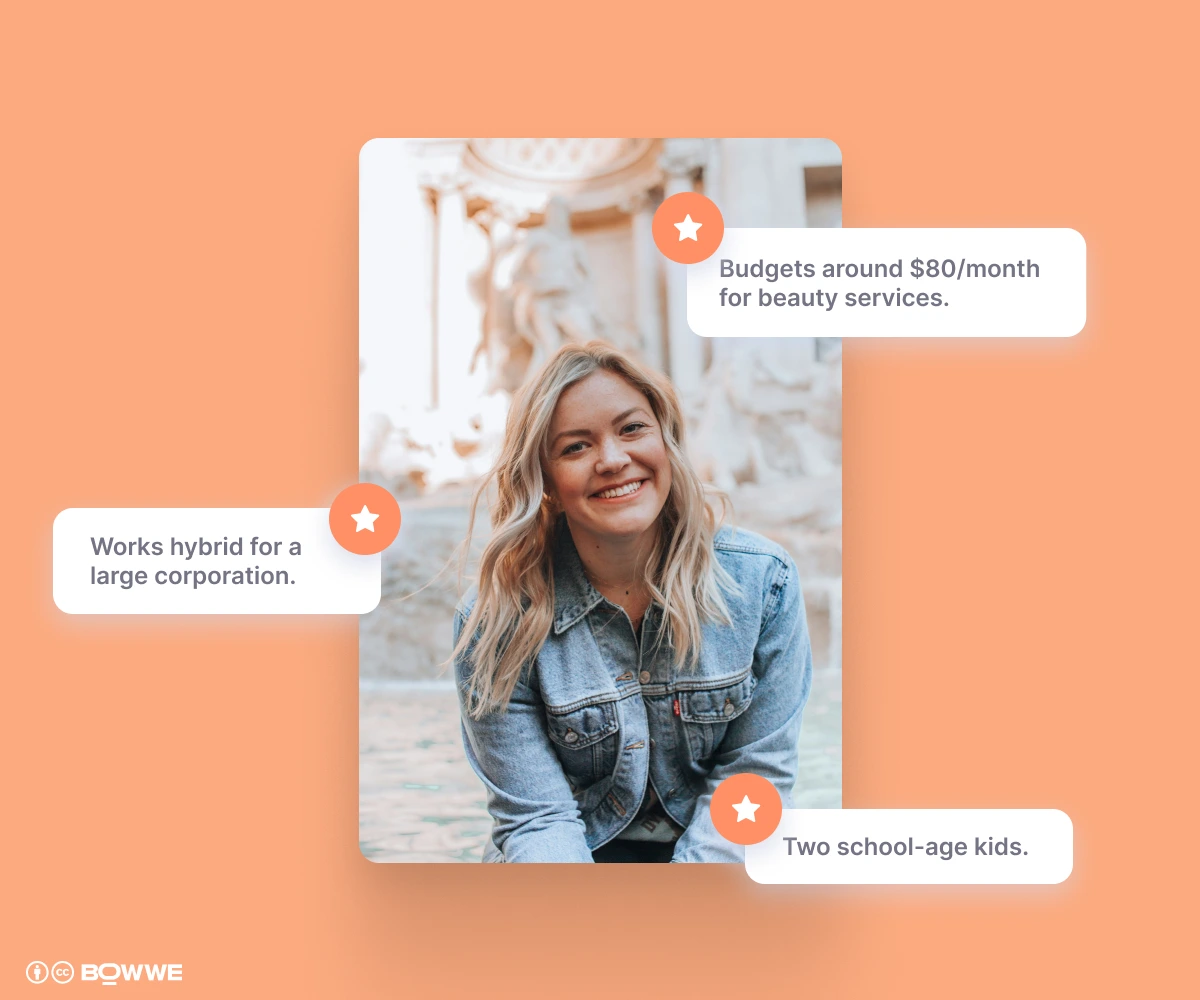
- Works hybrid for a large corporation.
- Lives in Los Angeles with her family.
- Two school-age kids.
- Budgets around $80/month for beauty services.
Goals:
- Easy online booking after 9 p.m.
- Modern treatments that fit both her budget and schedule.
Pain points:
- Difficult to book services after 5 p.m.
- Hates calling reception to book.
Offer/website must-haves:
- Badge: “Evening Appointments (6–9 p.m.)”.
- One-tap Apple/Google Pay deposit option.
2. Katrine – “Anti-Age Advocate” (Age 50)
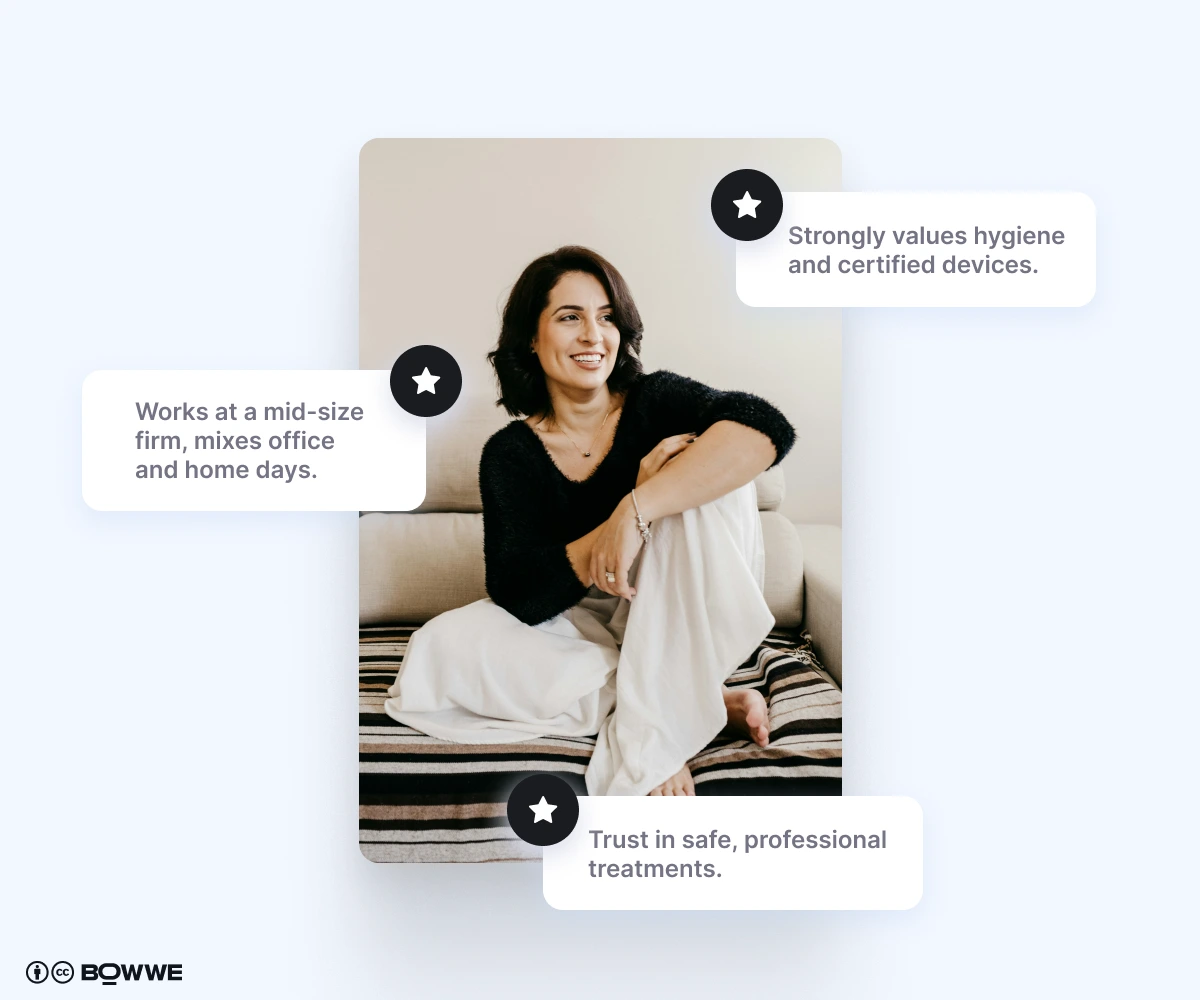
- Works at a mid-size firm, mixes office and home days.
- Actively searches for service bundles and expert credibility.
Goals:
- Noticeable anti-aging results.
- Trust in safe, professional treatments.
Pain points:
- Strongly values hygiene and certified devices.
- Skeptical without visible credentials.
Offer/website must-haves:
- “Mature Skin” filter in the service menu.
- Dermatologist quote + device certificates (PDF or badges).
- Before/after slider for RF-lifting & bio-stim facials.
- Off-peak package banner (Tue–Wed, 2 p.m.–4 p.m.).
3. Isabelle – “Trend Hunter” (Age 28)
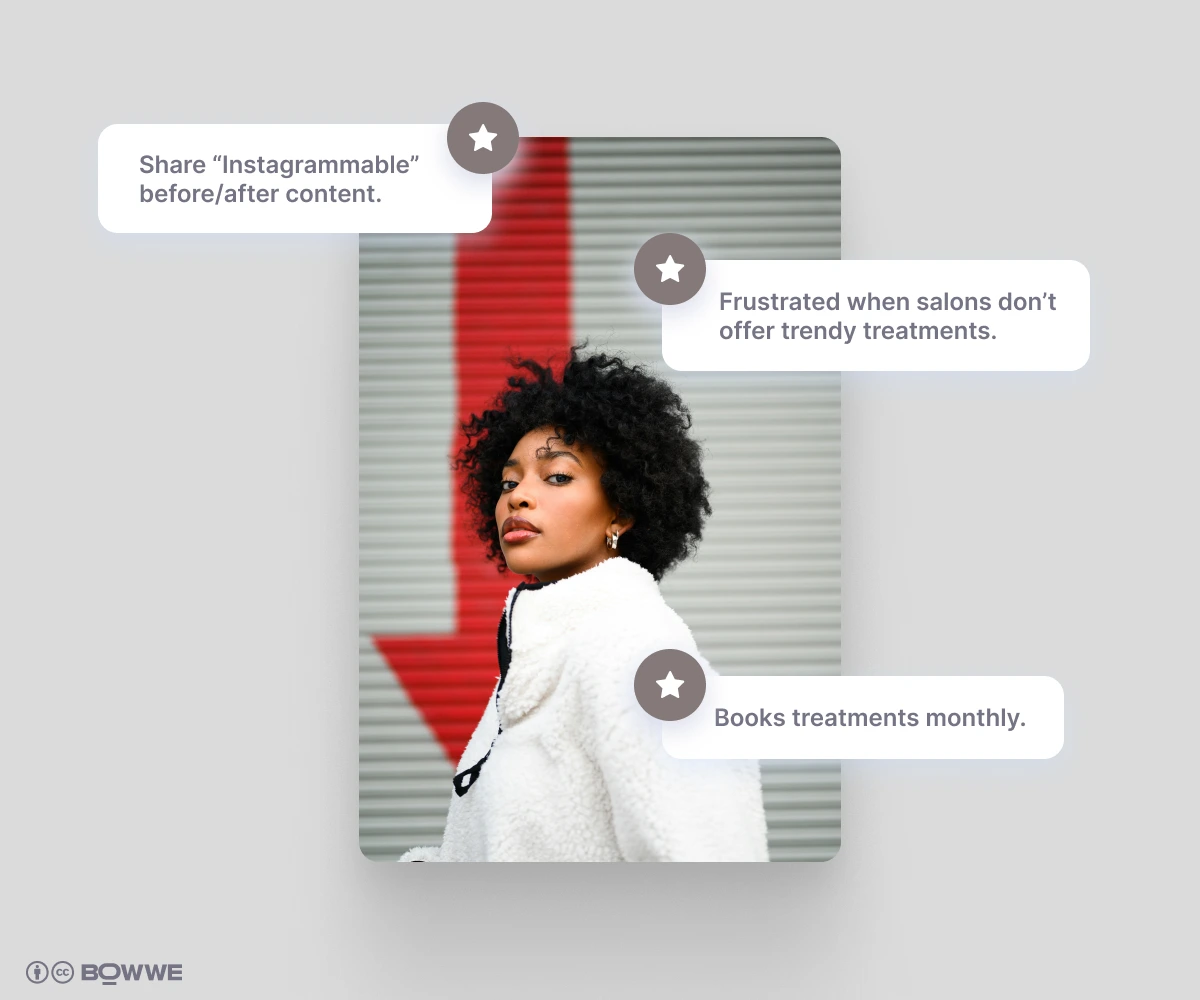
- Works in marketing/creative field.
- Loves Instagram reels and laser facials.
- Books treatments monthly.
Goals:
- Be first to try new beauty trends.
- Share “Instagrammable” before/after content.
Pain points:
- Frustrated when salons don’t offer trendy treatments.
- Loses trust if staff skills feel outdated.
Offer/website must-haves:
- Live Instagram feed integrated into homepage.
- Animated “Must-Have Treatments” grid (e.g., hydro-peel, RF microneedling).
- One-tap Apple Pay checkout.
- Price bundles with 3-visit discount badge.
4. Adam – “Time-Saver” (Age 40)
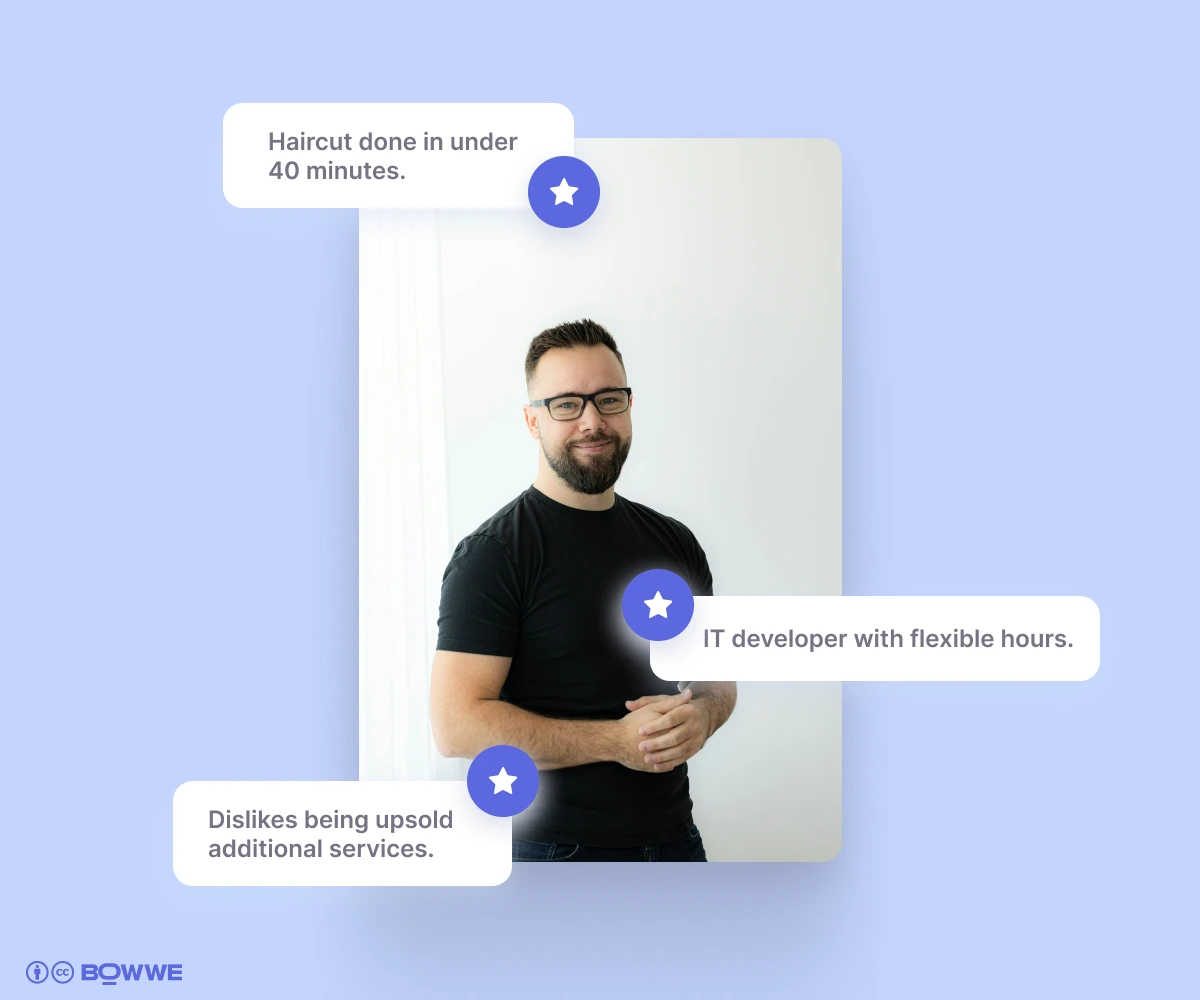
- IT developer with flexible hours.
- First visit recommended by his wife.
- Fine paying premium prices if service is fast.
Goals:
- Haircut done in under 40 minutes.
- Simple, no-nonsense grooming.
Pain points:
- Long visits frustrate him.
- Dislikes being upsold additional services.
Offer/website must-haves:
- Separate “For Men” section.
- Straightforward copy: “20-min Pore Cleanse • $45”.
- Before/after gallery featuring male clients.
- SMS reminders + Apple Wallet loyalty card.
How to use buyer personas in your beauty salon
Here are some practical ways to put them into action:
1. On your website:
Add a dedicated “For Men” section, highlight “Evening Appointments (6–9 p.m.)”, or feature trending treatments in a “What’s New” grid.
2. On your blog:
Publish persona-focused content, such as “Must-Have Treatments for Busy Moms” or “Top 5 Anti-Age Solutions for Women 50+.”
3. In your offers/packages:
Create bundles like “Skin-Age 50+ Packages” or “3-Evening For 15% Off”
4. In your marketing campaigns:
Run geo-targeted Google Ads, Instagram stories for trendsetters, or SMS reminders tailored to no-fuss male clients.
Beauty salon buyer personas - summary
- Identify and name your top personas.
- Reflect each one in your website, offers, and promotions.
- Attract traffic that matches their needs and expectations.
Do this, and you’ll turn casual browsers into loyal, site-booking regulars - without overspending on ads.
Ready to get started? Build your beauty salon website in BOWWE, drop in the right widgets, and watch your repeat bookings grow.
Start Creating
No coding experience required.
Beauty market segmentation - FAQ
What should be included in a beauty salon buyer persona?
How can I create a buyer persona quickly?
How do I sell an amiable personality in the chair?

Karol is an entrepreneur, e-commerce speaker among others, for the World Bank, and founder of 3 startups, as part of which he has advised several hundred companies. He was also responsible for projects of the largest financial institutions in Europe, with the smallest project being worth over €50 million.
He has two master's degrees, one in Computer Science and the other in Marketing Management, obtained during his studies in Poland and Portugal. He gained experience in Silicon Valley and while running companies in many countries, including Poland, Portugal, the United States, and Great Britain. For over ten years, he has been helping startups, financial institutions, small and medium-sized enterprises to improve their functioning through digitization.